
Finding 1
Executable states help when a task is a direct geometric operation on 3D structure, such as changing the viewpoint or moving rigid objects.
Novel views and viewpoint questionsFormulation
Video reasoning and generation both depend on the underlying world state: which entities exist, where they are, and how they and the camera move. VideoCoS makes that state explicit as an executable Blender program, built once per video, and asks when this helps.
Left: unlike models with implicit, entangled latents, VideoCoS codifies a video once into an executable program, an explicit, factorized and persistent state that an agent queries to answer questions, or edits and simulates to render new videos. Right: performance relative to the same base model without an executable state.
The codification agent turns perception evidence into an executable scene program through a loop of building, checking and rendering. The reasoning agent then reads this scene to answer questions, or edits and simulates it to generate videos. It receives only text feedback from tools and never sees the frames. Tool outputs here are illustrative.
Interactive
Each scene below is an executable world state, exported from its Blender file. Four things to try:
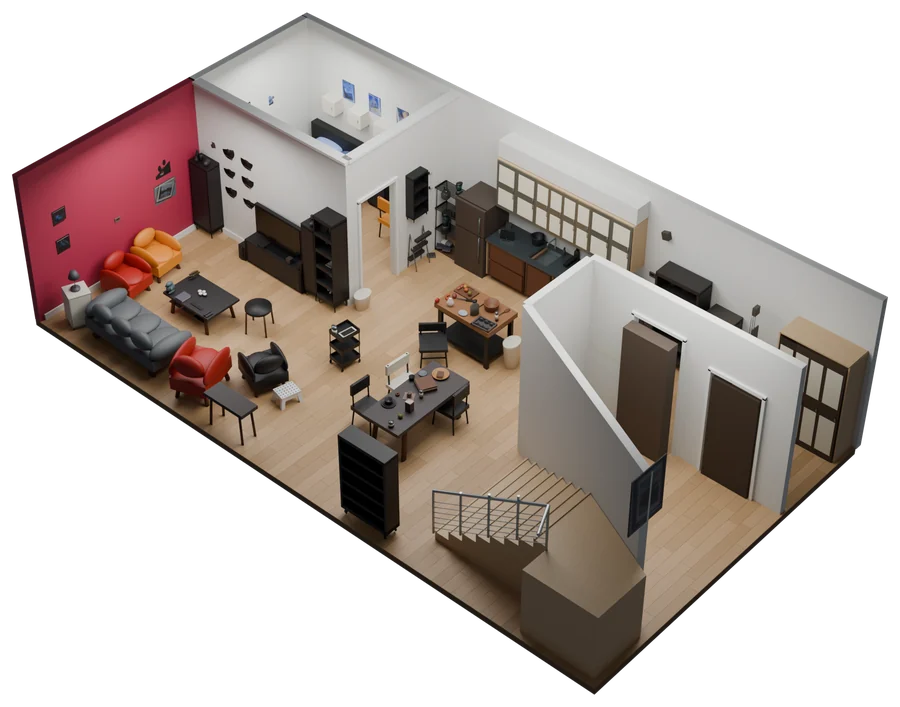
# Click an object to read its record.
The kitchen, bedroom, classroom and bathroom were codified by VideoCoS from raw video (rooms of VSI-Bench); their meshes are thinned for the web. The console values are computed in your browser from each object’s world-space bounds, the quantity the harness tools inspect_entities and measure_pair(metric="center") report: metres, Blender axes, Z up. Outer walls between you and the room are hidden.
Results
Each task family probes a different component of the state: its entities, their geometry over time, or the camera. Benchmarks ship no ground-truth scene programs, so every state below was inferred from raw video.
VSI-Bench-Debiased. The same reasoner answers from the video, or from a codified scene alone. Viewpoint questions gain most, by 21.9 and 17.5 points for GPT and Gemini; history questions lose for every reasoner.
Below, each room’s raw video beside three codified scenes of it: two from the agents of BVB, one from VideoCoS, each rendered through its own estimated camera.
Clips run at twice real time. These five rooms were chosen among those where the VideoCoS scene answers more questions. BVB’s scenes often look cleaner; VideoCoS follows the camera pose and the object layout of the video more closely.
Kubric-4D. The agent writes only the camera, and Blender renders the same scene again. VideoCoS leads on both metrics at every camera shift, and its object mIoU stays at 0.224 to 0.254 from 42° to 128°.
Drag across the video to wipe between a method and the true target view. All five views of both scenes play below.
Ego2Act. From one start photo and a goal, the agent keyframes rigid object motion in Blender. Rendered in Blender, VideoCoS has the second-highest task score after Seedance-2.0, and the lowest physical score: the plan has no hand. Conditioning MiniMax-H3 on the plan adds one. The clips compare it with four video generators.
The baseline clips are the generations released with Ego2Act (seed 101); a clip shorter than 15 seconds holds its last frame. The Blender + MiniMax-H3 clips use the full MiniMax-H3 model.
Physics-IQ. The agent sets up rigid-body physics in the codified scene and simulates the next five seconds. Its rigid trajectory error (11.1) is close to Cosmos3 (10.3 and 10.5) and well below MiniMax-H3 (16.1); on non-rigid motion and on the Physics-IQ score it trails.
Every method continues the same three observed seconds; the clips are its next five. The Blender + MiniMax-H3 clips use the full MiniMax-H3 model.
Findings
Every task on one axis: how much the same model gains or loses once it works through an executable state. Switch the reasoner, hover for the raw numbers, click a bar to see its results.
Finding 1
Executable states help when a task is a direct geometric operation on 3D structure, such as changing the viewpoint or moving rigid objects.
Novel views and viewpoint questionsFinding 2
Executable states fall short when an answer combines several noisy state estimates or requires physical realism (hands, non-rigid dynamics, photorealism).
Physics and plausibilityFinding 3
Executable states can beat video despite imperfect reconstruction, but error tolerance varies by task, and a wrong state hurts more than a missing one.
Reads from codified scenesState errors compound across the estimates an answer combines; state accuracy, not visual similarity, predicts question accuracy; code input tolerates moderate error.
Cite
@article{yu2026videocos,
  title   = {VideoCoS: When Do Executable World States Help Video Reasoning and Generation?},
  author  = {Yu, Shoubin and Lee, Daeun and Wang, Zun and Lin, Han and Zhang, Yue and Bansal, Mohit},
  journal = {arXiv preprint},
  year    = {2026}
}